Thursday, August 28, 2014

How long does it take for a Jehovah's Witnesses to know more than MDivs & Doctorates?

"20 seconds" - Walter Martin

Honestly it depends on the specific subject. But notice what the "MDivs & Doctorates" themselves have said:

“Jehovah’s Witnesses can make a doctrinal pretzel out of the average Christian [Trinitarian] in 20 seconds,” the late U.S. evangelical minister Walter Martin once said.

American Christian fundamentalist Ron Rhodes said Jehovah’s Witnesses pose a significant challenge. “They have been trained better than any Christian [Trinitarian] denomination that I’m aware of.”[1]

“Christians [Trinitarians] tend to be inept at responding to antitrinitarian thought and argumentation of ... Jehovah’s Witnesses.”—Contending with Christianity’s Critics: Answering New Atheists and Other Objectors, page 205. By Paul Copan and William Lane Craig.[2]

LINK

(Question closed soon after I answered.)

Footnotes:
[1] Witnesses keeping the faith http://www.canada.com/story_print.html?id=b3d5d95d-c598-43e5-8c0c-6811dd1895ed&sponsor=

[2] The complete quote is: “inept at responding to antitrinitarian thought and argumentation of Muslims, Jehovah’s Witnesses, or Mormons.”

Additional reading:

Thursday, August 7, 2014

Trinitarians: how was Jesus strengthened by an angel?


At Luke 22:42 Jesus is praying to the Father for strength, and verse 43 has an angel strengthening him.
  • Trinitarianism teaches that Jesus is a divine person with human and divine natures.
  • Trinitarianism teaches that it was Jesus' human nature that needed strengthening.
So why wasn't the divine person of Jesus able to strengthen his human nature?

One answer:
When you read the commentary on this scripture, they say those exact words. They say his human nature, being lower than his divine nature, needed cheering and support.

This makes no sense when you think about it. It means the divine nature was incapable of doing anything. Notice, this is the second time angels came to strengthen him. The first is at Matt 4:11.
Me:
Excellent reference. Mat. 4:11 says "angels came and began to minister to him." If Trinitarianism were true, then surely those angels would not be so indiscreet to presume that they could encourage the human nature of the divine person of Jesus!

An answer from a Trinitarian:
1) Trinitarians: how was Jesus strengthened by an angel?

Supernaturally, of course. The Bible doesn't give the details - so how would anyone know the details? You don't; I don't. Jesus knows.

2) So why wasn't the divine person of Jesus able to strengthen his human nature?

Who told you that it wasn't? Why did you believe them? The Bible certainly does not teach that the divine person of Jesus was unable to strengthen his human nature. Are you saying that non-Biblical doctrine is one you accept as true?
Me:
Hi! "Who told you that it wasn't?" Luke 22:43.

"The Bible certainly does not teach that the divine person of Jesus was unable to strengthen his human nature." Then why did he rely on an angel?

If the Trinitarian paradigm is true, then it is most inappropriate for a mere angel to strengthen Jesus' human nature when his divine person was fully capable of doing so. Hence, my question.
Trinitarian response:
I don't know why he relied on an angel - and neither do you. Why did God rely on an angel for anything? God relies on angels throughout the Bible - though the Bible never tells us why he does so, and it is absolutely certain that he does not NEED to do so.
Me:
God uses angels in the OT but never to receive strength. But I'm glad to see you say that you don't know, that was humble of you.
Related reading:
Could Jesus Have Had Faith in God?

Related blog entries:
Defending Trinitarianism
Who was the Interceding Angel?

Monday, June 2, 2014

When Jesus said "No one is good except God alone"?


Based on these three scriptures, especially the last two:

Matthew 19:17
“Why are you asking Me about what is good? There is only One who is good."
Mark 10:18
“Why do you call Me good? No one is good except God alone."
Luke 18:19
“Why do you call Me good? No one is good except God alone."

(All from the New American Standard Bible)

Thus we have a question followed by a clarification.

Can the question be understood as:

(1) A Repellent Question indicating an objection?
Jesus was no stranger to Repellent Questions, as he used one on his own mother in John 2:4, “Woman, what does that have to do with us? My hour has not yet come.” Meaning, “Don't tell me what to do, it's not time yet.” Thus, as applied to this question, Jesus said: "Don't call me good, for only God is good (and I'm not God)!"

(2) Or can the question be understood in the Trinitarian sense of Jesus making us "stop and think for a moment about who Jesus really was." (NET Bible footnote for Mark 10:18) As in, "Stop and think, if I'm good and God is good, then I must be God in the sense of God being an impersonal construct and me being the second person within it in hypostatic union with my human nature!"

But Jesus also declared that the Father is the "only true God," thus God is a singular person, the Father at John 17:1-5.

So, which option is more reasonable with scriptural precedent?

Update: If #1, Jesus is calling God good in the sense of recognizing his Father as the ultimate standard of what is good. (Not that everyone else is evil as someone suggested. Their post is now gone for some reason.)

@ XXX1, hi there. Philippians 2:6 can be translated differently and that chapter actually does not support Trinitarianism, but that's a separate subject. Seeing Jesus is seeing the Father in the sense that Jesus perfectly represents his Father, and actually works against the Trinity the way you're using it as Jesus is not his Father. John 17:5 confirms Jesus' prehuman existence in heaven. No support for the Trinity there either.

Update: @ XXX2: Please be advised that 1+1+1=3, not 1. I also note that your comment is mere spam for the Trinity and actually does nothing to address this question.

Update: @ XXX3: As I wrote above, Jesus is calling God good in the sense of recognizing his Father as the ultimate standard of what is good, not that Jesus and everyone else are evil--they are just excluded from being the ultimate standard of what is good.

Jesus Christ ALWAYS deflected attention away from himself and directed it towards his Father. (John 7:16-18; 12:28; 17:6)* Could the same be true with this question I'm asking?

* Look up Scriptures here: http://tinyurl.com/au2mfwx

And as you know, Jesus and his Father are one in purpose just like Christians and Jesus are one--John 17:21.

Best Answer Asker's Choice

Greetings,

Some Trinitarians say that Christ wanted the man to realize that his calling Jesus "good" meant Jesus was God since only God is good.

Non-Trinitarians interpret this as an example of Jesus denying that he was equal to God: the man was using the title improperly in an absolute sense and Jesus corrected him showing that only God should be considered to be supremely good, and not Christ.


What is clear is that the Trinitarian interpretation must arbitrarily import ideas into the text. Nothing in the context leads to the conclusion that Jesus wanted the man to believe Christ was equal to God. This conclusion has to be forced into the text by a presupposed theological bias. Further, the grammar argues against it. This is noted even by many Trinitarian scholars:

Interpreter's Bible:
"Why do you call me good? ...later theologians interpreted it otherwise: 'If you call me good, you imply that I am God'--but this is wholly impossible, both in the original setting and for Mark." (7:801).

The Catholic NAB:
"Why do you call me good?: Jesus repudiates the term "good" for himself and directs it to God, the source of all goodness who alone can grant the gift of eternal life; cf. Mt 19:16-17"--(ftn. on Mk. 10:18).

John A.T. Robinson:
Footnote:"Indeed, by implication he DENIED being God: 'Why do you call me good? No one is good but God alone'" (Mk 10:18)--(Honest To God, pp. 72-73).

The literal rendering of Luke 18:19 is: "There is none good, but the one God" (EI MH EIS hO QEOS). Use of the article (hO QEOS) here is significant. In Mark only the Father is hO QEOS, never Jesus (cf. 15:34). Christ's words then specifically identify God the Father as the only one who is good and explicitly excludes himself (and all others). Jesus could not have used this syntax to mean what Trinitarians claim. This fact is placed beyond debate when we notice the same exact Greek expression in other passages that have no theological baggage.

For instance: Mk. 2:7: "Why is this man talking in this manner? ...Who can forgive sins except one, God?"

This question and answer is almost an exact parallel, making it very clear that the grammatical structure is designed to exclude the subject from the identification in the response. The Pharisees certainly wanted to explicitly exclude Jesus from being God. Their argument was explicit: "This man is NOT God since ONLY God can forgive sins."

If Jesus meant to imply that he be considered "good" in the sense the man used why would Jesus use syntax which could only be understood as excluding himself?

The ultimate and final authority on what Jesus meant lies in how the man understood the correction. We get a definite answer when the man in his very next words dropped the "Good" and addressed Jesus simply as "Teacher." It was obviously very clear to the man that Jesus was excluding himself from being called good since he was not God. Jesus obviously thought the man got the correct point since he did not correct the man this time. Rather, Jesus "loved him" and invited him to be his follower! Would Jesus have done this if the man was so obtuse as to miss or reject Jesus' point?


In conclusion, it is first clear that the context and the grammar shows that Jesus gave no indication that the man must recognize he was Almighty God. To the contrary Jesus' response was a clear correction of what was said, rejecting the application of the term "good" to himself in this circumstance.


The fact that others are properly called "good" in the Scriptures proves that Christ was obviously applying "Good" in an absolute sense here. If he wasn't using it in an absolute sense, then his statement that "No one is good except God alone" would be a lie. This is because the word "good" (Grk. agathos) is properly used in Scripture of many things, even by Jesus Himself as a generic term for others. (Matt. 5:45; 12:35; 13:38; 22:10; 25:21,23).

Normally, calling Jesus "good" was appropriate. Yet, in this context the man was placing Jesus as ultimate/supreme judge of what is required for eternal life. The man seemed to be assuming Christ was so "good" that he could decide the requirements for salvation on his own.

Colin Brown Theological Dictionary:
"What stands out is what has been asserted in every period of Israel's history,... namely that God himself is the One who is really and exclusively good. In the language of the LXX, he is the highest good....However, this does not prevent a natural application of the predicate "good" to the moral differences between men, who do good as well as evil (Matt. 12:35; 25:21; and par. Lk. 6:45; 19:17)."

Yours,

BAR-ANERGES

Asker's rating & comment

5 out of 5
Thank you, the Colin Brown Theological Dictionary quote was excellent! Why Trinitarians can't understand this is quite revealing...

LINK

Monday, May 12, 2014

Is Behemoth a dinosaur? Is this based on Job 40:17 only?

Job 40:17 states that it moves or bends its tail like a cedar. Based on this, some identify Behemoth with a sauropod dinosaur. But notice:

40:21 states that it lies under the lotus tree, is concealed by reeds, and lies in swamps. Verse 23 adds that it lives in a raging river. Both conditions are physically impossible for a sauropod dinosaur. Note that in verse 17 it's the actions of its tail that are compared to a cedar, not that it looked like a cedar, otherwise its long neck would look like a tree too, but no mention is made of that.

Plus, verse 19 indicates that it has a "sword," understood to be tusks. The NET Bible in its footnote states: “The sword is apparently a reference to the teeth or tusks of the animal, which cut vegetation like a sword. But the idea of a weapon is easier to see ... The [Revised Standard Version] probably has the safest: ‘He that made him has furnished him with his sword’ (the sword being a reference to the sharp tusks with which he can attack).” It must be noted that sauropods do not have tusks, but the hippopotamus does have two dangerous tusks that can penetrate crocodile hide. Likewise, the hippopotamus uses its tail for a variety of important functions, thus it acts as a strong and stiff appendage.

Thus, considering all the verses that exclude a dinosaur identification, is it only verse 17 that dinosaur-proponents use?

Related point:
Have dinosaur and man footprints been found together? Creationists say no:
"In 1986 a number of leading creationist researchers decided that the evidence of supposedly human and dinosaur footprints, found together at the Paluxy River in Texas, had *serious problems*. They decided that, pending further research to establish the correct interpretation of the prints, they could *no longer be safely used as evidence* ... that man and dinosaur lived at the same time."
http://www.answersingenesis.org/articles/cm/v25/n2/magic-bullet

Select responses to an interlocutor:

It's not necessarily about one's worldview, but about reading comprehension and honesty. The habitat of both Behemoth and Leviathan is described as being associated with water, so they cannot be dinosaurs since dinosaurs were primarily terrestrial. Some could have visited watery places, but they could not have lived there like Behemoth and Leviathan. About Job 40:17: You're evidently confusing "looking like" with "acting like." Being stiff like a cedar matches a hippo tail just fine. Like I said, it's not about worldview but about reading comprehension. Also, animal death and human death are different per Ecclesiastes 3:19-20 and Psalm 49:12. Since man has fallen into sin and death, he is now at the same level as the beast.

I am not arguing semantics. I am arguing for accuracy. Dinosaurs do not match the descriptions in Job 40-41. 40:23 certainly does show that Behemoth withstood rushing rivers. Otherwise, it could have said anything no matter how unrelated. And I have a professional library on paleontology, so your quote there is either outdated or from an inaccurate source. The quote from Faussett, Jamieson, Fausset & Brown is reading way too much into a simple verse. Again, it's not about worldviews, but about responsible reading comprehension.

(I had another response, but Yahoo! deleted it when it switched over to a new format. It went something like this:)

About Mokele-mbembe, I noticed that in 2006 National Geographic had an expedition that failed to find it. I believe it remains elusive.

Thanks for posting that website. It appears to answer my question that the sauropod identification is based solely on Job 40:17. Also, concerning Leviathan, it compares the description of pyrotechnics in Job 41:18-21 with a bombardier beetle that sprays a high-temperature jet of gas out of its hind end. Problem: the Leviathan's pyrotechnics come from its head, not behind. Wrong end!
============================

Let me include the entire discussion log. At the time of me originally posting this, it appeared to be truncated as I commented on above, but it is all included now:

Update:
@ Donald: Hi there! Even a child can see that sauropods do not have horns or tusks.

@ Robert: Hi there! You're playing fast-and-loose with those definitions.

Update 2:
@ I worship Jehovah: Hi there! Actually the crocodile has been identified as Leviathan. Since we're on that subject, the Leviathan spends time in the water per 41:31-32, thus also not a dinosaur to educated people.

Update 3:
@ Donald again: ironically, what's "patently absurd" is that definition which ignores the entire description of Behemoth. Very dishonest and sensational in fact.

Update 4:
@ Alex de Alex: Hi there! It's not necessarily about one's worldview, but about reading comprehension and honesty. The habitat of both Behemoth and Leviathan is described as being associated with water, so they cannot be dinosaurs since dinosaurs were primarily terrestrial. Some could have visited watery places, but they could not have lived there like Behemoth and Leviathan. About Job 40:17: You're evidently confusing "looking like" with "acting like." Being stiff like a cedar matches a hippo tail just fine. Like I said, it's not about worldview but about reading comprehension. Also, animal death and human death are different per Ecclesiastes 3:19-20 and Psalm 49:12. Since man has fallen into sin and death, he is now at the same level as the beast.

@ a Real Truthseeker: Looks like your answer is a blind cut-and-paste job that has nothing to do with seeking truth. Step one in truth seeking is READING.

Update 5:
@ Alex de Alex again: I am not arguing semantics. I am arguing for accuracy. Dinosaurs do not match the descriptions in Job 40-41. 40:23 certainly does show that Behemoth withstood rushing rivers. Otherwise, it could have said anything no matter how unrelated. And I have a professional library on paleontology, so your quote there is either outdated or from an inaccurate source. The quote from Faussett, Jamieson, Fausset & Brown is reading way too much into a simple verse. Again, its not about worldviews, but about responsible reading comprehension.

Update 6:
You're welcome Alex, and thank you for the dialog. About Mokele-mbembe, its identification remains elusive, so it really cannot be called a sauropod. Wikipedia has a nice summary too. It says that in May 2006, National Geographic tried to find it, but failed. The "Dinosaurs and the Bible" site answers my question, that the dinosaur identification is based solely on verse 17, and a misreading of it at that, and dismissing the other the verses that exclude a dinosaur identification. (Dismissing verses in God's word!) It says it was brachiosaurus, yet it is known that it did not have tusks or horns and it is much too large to have found shade under the lotus tree. Good reading comprehension would have saved them from that egregious blunder.

Update 7:
(As an aside, that site, like other YECs, identifies Leviathan with Kronosaurus, not a dinosaur but an aquatic pliosaur. The pyrotechnics in Job 41:18-21 are hyperboles like elsewhere in Job's descriptions [see how the horse is described with exaggerations in Job 39:20, 22, 24]. But the site compares these pyrotechnics to the bombardier beetle's. One problem with this: The beetle is specifically designed to dispense with its noxious chemical spray in a rapid burst of pulses from special glands in its abdomen, not in its mouth. Wrong end. Thus, Leviathan's pyrotechnics are hyperbolic for the fear of death it gives its observer. Their exegesis is thus seen to be cartoonish.)


LINK

See also:

Are dragon legends evidence that dinosaurs lived with man, or?

Are dragon legends evidence that man found dinosaur bones and told legends about them?

Which is more reasonable?

(And the Bible book of Job does not describe dinosaurs, so please do not use that reasoning.)

Dino and man footprints found together? Creationists say no:
"In 1986 a number of leading creationist researchers decided that the evidence of supposedly human and dinosaur footprints, found together at the Paluxy River in Texas, had serious problems. They decided that, pending further research to establish the correct interpretation of the prints, they could no longer be safely used as evidence ... that man and dinosaur lived at the same time." (emphasis added) http://www.answersingenesis.org/articles/cm/v25/n2/magic-bullet

About Behemoth in Job, please read in 40:21 that it lies under the lotus tree, is concealed by reeds, and lies in swamps. Verse 23 adds that it lives in a raging river. Both are physically impossible for a sauropod dinosaur. The actions of its tail in verse 17 are compared to a cedar, not that it looked like a cedar, otherwise its neck would look like a tree too, but no mention is made of that.

LINK

See also:
Credits:
  • Picture from the young-earth creationist book Dinosaurs of Eden.

Wednesday, April 23, 2014

Trinitarians: what exactly did Jesus sacrifice?


Trinitarians have told me that Jesus took back the same body that was crucified and that Jesus didn't die because he is the immortal second person of the Trinitarian Godhead and that he also has an immortal soul.

So, the person of Jesus didn't die, it was his human nature that died, but he got that back when that was resurrected and rejoined with his immortal soul and divine nature which obviously never died.

So since Jesus AS A PERSON never died (as he was conscious as a divine person and an immortal soul while his human nature was dead) and since he got his same body back, then what exactly did Jesus sacrifice?

References:

“Jesus died physically, but remained alive spiritually,” and that Jesus’ “essence did not die, nor could it” and “His physical body died, but His inner being is eternal and could not die.” (Houdmann, S. Michael. “Did God die? If Jesus was God, and Jesus died on the cross, does that mean God died?” www.gotquestions.org/did-God-die.html) This position was also presented by one of the brightest minds of Trinitarianism, Dr. William Lane Craig, in this video: “Was God Dead for Three Days?” youtu.be/g4uhWvEpAvk [1]

Also, blood is liquid flesh so when the resurrected Jesus said he was "flesh and bones" blood was clearly included as he was not a zombie.

To review:
What did Jesus sacrifice that he did not still have or get back per the Trinitarian paradigm?

[The Trinitarian responses were that Jesus sacrificed his blood and that he was separated from the Father. But they also openly and publicly declare (wittingly or unwittingly) that Jesus still had blood and that he was NEVER separated from the Father as he was the second person of the impersonal Trinitarian Godhead the entire time. Thus, my question remains open.]

Footnote:
[1] Specifically from 0:55 to the end. Here he stated:
“So when Jesus died on the cross, his human nature died, not his divine nature, he died as a man. Human death is the separation of the soul from the body, and that's what happened when Jesus expired on the cross. His soul was separated from his body, which then became a lifeless corpse and was laid in the tomb, and then later we Christians believe was raised from the dead. So you can see that the divine nature, the divine person of Christ, is not in any way, um, extinguished in the death of the human nature of Christ on the cross.”
Thus he confirms the Trinitarian position that the person of Jesus never died, it was just his human nature on earth that expired. See also “Do You Reject Trinitarianism? (Point 1).” jimspace3000.blogspot.com/2010/11/normal-0-false-false-false.html

Link

Monday, March 24, 2014

JW's, Can you explain to me why the Holy Spirit is an Active Force instead of a 3rd person in a trinity?


i would like as much info as i can about the holy spirit, thanks.


Answer:

Consider the virgin birth of Christ. If the holy spirit is a person, the third person of the Trinitarian Godhead, then a person is responsible for Mary's pregnancy. Period. (Or in Mary's case, no period.)

Thus, it sure sounds like Trinitarianism unwittingly teaches that God had sex with Mary. It looks like a sexual union of an alien person with a human female, giving the holy spirit the role of an incubus.

If Trinitarianism responds saying that the Holy Spirit Person of God (God the Holy Spirit) used power to make Mary pregnant, then how is that any different from the holy spirit being a spiritual energy, an active force from God fulfilling God's purposes?

But there is something else to ponder. If the third person of the Godhead, the holy spirit, begot Jesus, then why is the first person of the Godhead, the Father, the father? Should it not logically be the holy spirit person? That it's not Jesus' father is another devastating yet ignored dilemma for Trinitarianism.

============
Edit:
2 Corinthians 3:17 "Now Jehovah is the Spirit." Since Jehovah is the Father, who per Trinitarianism is the First Person of the Trinitarian Godhead, this does nothing to address the Holy Spirit person. It is clearly teaching that the Father Jehovah has spirit nature. So Trinitarianism must desist from misusing this scripture like it does address the Holy Spirit person when it most clearly does not.

In conclusion, the preponderance of scriptures makes the holy spirit impersonal. Other scriptures that have the holy spirit speaking are anthropomorphisms. Remember, if the holy spirit is a person, then:

  1. The holy spirit filled the role of an incubus
  2. Mary was not a virgin mother of Jesus
  3. The holy spirit is Jesus' father, not the Father person

All three of these are anathema. Thus, we can be most thankful that the holy spirit is an 'active force.'

@ [name removed]. Thanks for asking. Trinitarianism teaches that a person got Mary pregnant. That it was a divine spirit person is irrelevant. The Trinitarian Holy Spirit acted like an incubus demon and simulated sexual intercourse with Mary, getting her pregnant. Thus, she could hardly be an honest virgin. Jesus replaces Adam as our father, and it is significant that Jesus never called the Holy Spirit his father, like he surely would have if Trinitarianism were true. Mary is only an honest virgin if the holy spirit is an impersonal utilitarian divine energy.

@ [name removed]: Trinitarianism teaches that the Holy Spirit person got Mary pregnant. What you're uncomfortable with are the unrealized implications of that doctrine. Mind you, I'm being objective as opposed to warped.


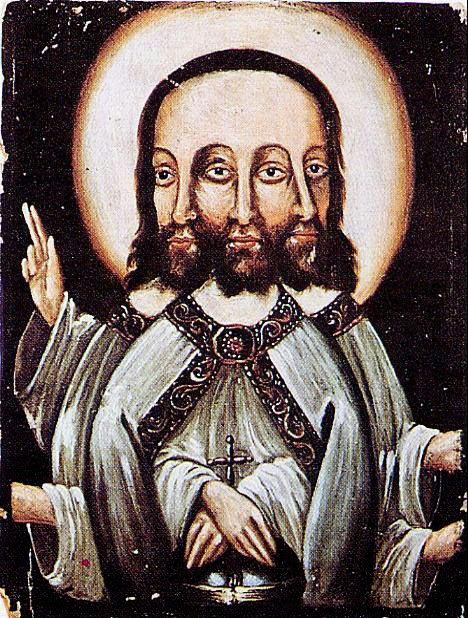
Note: The iconographic depiction of the Trinidad trificela (three-faced Trinity) seen above fell into disuse after being outlawed as heterodox in the wake of the Reformation.